July 8, 2011

Dr. Pascal Binda
Southern Wesleyan awarded AdvanceSC grant
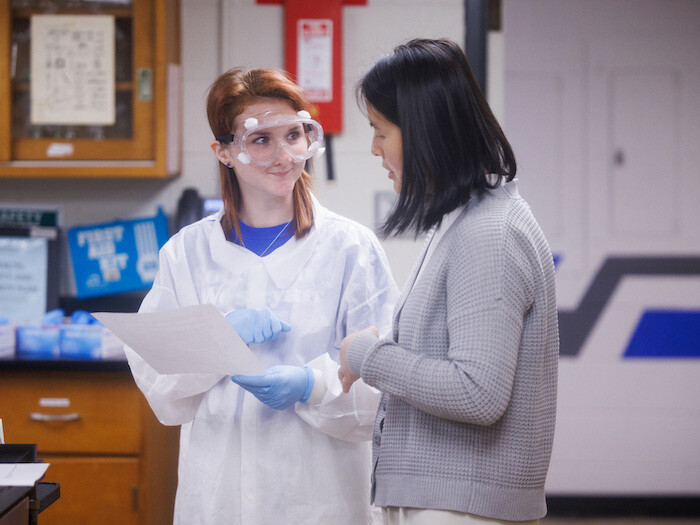
Southern Wesleyan University has received a $50,000 grant for Chemistry Professor Pascal Binda’s project entitled, “Designing new catalysts for the synthesis of polylactide polymers with enhanced degradation rate in composting environments for use in packaging applications.”
This project involves designing better catalysts that allow for varying rates of polylactide decomposition according to the type of packaging. Some types of polylactide polymer, a packaging material, require longer decomposition times, while other types of packaging materials require a quicker decomposition.
The grant is awarded by AdvanceSC, a company that funds economic development projects in the Upstate. According to Binda, the grant will provide chemicals and financing for research. He said that most undergraduate students require technical skills in conducting scientific research to be successful in manufacturing industries and graduate school projects.
“Getting this funding is a huge advantage for us,” Binda said. “We can carry out projects with students who are passionate about research and development in chemistry, but don’t always have the resources and finances available to carry out the project.”
In addition to providing first-year funding for the university’s scientific research project, the AdvanceSC grant aids in promoting and developing student proficiencies for high-tech and highly skilled manufacturing jobs. Southern Wesleyan University’s collaboration with Sealed Air Corporation for testing and evaluation is also an integral component of the project.
AdvanceSC supports economic development, education, manufacturing and public assistance agencies in Duke Energy’s South Carolina service area. Established as a limited liability company by Duke Energy in 2004, AdvanceSC is funded with profits from the company’s Bulk Power Marketing program and is managed by a board of Upstate South Carolina leaders. Grant applications and information about AdvanceSC are available on its web site at www.advancesc.org.
Inventive fun at Southern Wesleyan University |
||
![]() |
Southern Wesleyan University is hosting young aspiring inventors on its campus in Central this week. The camp, organized through a partnership with Invent Now Kids, is for children entering grades one through six. This summer day camp makes textbook concepts of science, technology, engineering and math come alive through imaginative play that reinforces and supplements what youngsters learned throughout the school year. The camp runs June 6-10 at Southern Wesleyan. This year's sponsors are Duke Energy and Liberty Elementary's Learning Lab. Ashley Wood Perry, a Southern Wesleyan graduate who teaches chemistry and biology at Seneca H.S., is coordinating the camp. Invent Now is a program that looks for new and creative ways to spread the inventive spirit and develops a range of creative products, programs and innovative partnerships that emphasize the importance of invention in society. | |
|
|
||
Alum hooded as physician's assistant at Trevecca Nazarene |
||
|
|
Brianna Garrison, a 2009 Southern Wesleyan University biology graduate, was hooded as a physician's assistant during a ceremony at Trevecca Nazarene University in Nashville, Tenn. Pictured from left is Art Johnson, her stepfather; Wendi Johnson, her mother; Garrison; and her husband Ben Garrison. She earned master's degrees in science and medicine. Garrison will officially complete her program after three months of clinicals. She resides in Kernersville, N.C. |
|
|
|
|
Deng accepted to Mercer and Armstrong Atlantic |
|
|
|
Abraham Deng, a 2007 pre medicine/dentistry graduate, was accepted into Mercer University's McAfee School of Theology and Armstrong Atlantic State University. He chose to study in the master of arts in Christian Ministry program at Mercer. Deng will also receive scholarships from Mercer and become involved in mission trips, which will include a trip to Atlanta to help the Lost Boys of Sudan who are living there. He will also help to build a school in his native village of Duk in Southern Sudan, provide water wells and help in providing prosthetic legs to those who lost limbs. Deng was among the estimated 20,000 Lost Boys who were affected by the Sudanese Civil War and were orphaned or separated from their families |
|
|
|
Chemistry majors offered summer research internships |
||
![]() |
Two Southern Wesleyan University chemistry majors have been offered paid summer research internships. Corey Clardy, a rising senior from Liberty, has been accepted in a Research Experience for Undergraduate (REU) program at the University of North Dakota to carry out summer research work. Also, Bryce Duncan, a rising senior from Asheboro, N.C., will continue his summer research internship at the Oak Ridge Institute for Science and Education (ORISE). According to Pascal Binda, assistant professor of chemistry, the internships will help the students gain experience in independent research work as they prepare for graduate school. | ![]() |
|
|
||
Looking into new worlds
Abby Holcombe, right, a freshman biology major from Pickens, shows an eighth-grader one of the microscopes in the biology lab during a science fair held March 25 at Southern Wesleyan University in Central.
Young scientists gather at Southern Wesleyan
Area youngsters immersed themselves into the world of science during a science fair March 25 at Southern Wesleyan University.
Southern Wesleyan hosted home-schooled students from the fifth through eighth grades. Also on hand was a group of students from R.C. Edwards Middle School. Nearly 50 students were involved in the fair, according to Dr. Walt Sinnamon, dean of the university’s College of Arts and Sciences. In addition to the experiments, the youngsters got some hands-on experience in the science labs, assisted by Southern Wesleyan science majors.
Coordinated by Dr. Paul Jordan, professor of computer science, and Dr. Susan Rouse, professor of biology, the science fair enlisted members of Southern Wesleyan’s science faculty, science students and Duke Energy employees. In addition to providing their employees as judges, Duke Energy donated $1,000 in support of the event. Chick-fil-A of Clemson and Seneca also helped with food for lunch after the fair.
“The donation from Duke has allowed us to do much more with the fair this year,” Sinnamon said. “I am very proud of our science division majors who helped in numerous ways before, during and after the science fair. Parents of participants have had very positive things to say about our students.”
Sinnamon hopes that the science fairs will expand each year and that a number of the participants will someday be Southern Wesleyan students and ultimately graduates, whether in the science division or in another major.
Daniels accepted into Ph.D. program
Recent Southern Wesleyan University graduate Brian Daniels was accepted into the Ph.D. program in neuroscience at Washington University in St. Louis for fall 2010. Daniels graduated in May with a bachelor of Arts degree in English and a bachelor of science degree for a specialized major in integrated behaviorial biology. He said that his acceptance “truly is a dream come true.” According to Daniels, Washington University’s neuroscience program is among the top 10 neuroscience programs in the nation.
Southern Wesleyan Grad Named Top Biology Teacher
Michel Justus, a 1995 graduate of Southern Wesleyan University, recently received the 2010 Outstanding Biology Teacher Award for South Carolina from the National Association of Biology Teachers. She has taught at various high schools across the state for 12 years and taught biology and anatomy and physiology at Central Carolina Technical College in Sumter, S.C. The daughter of Dr. Walt Sinnamon, dean of arts and sciences at Southern Wesleyan University, Justus earned her bachelor of science degree in biology with a minor in chemistry from SWU. She also earned a master’s degree in life science from the University of Maryland. Justus will be recognized at the National Biology Teachers Convention in Minneapolis, Minn., in November. Justus currently teaches biology, including advanced placement biology, at D.W. Daniel High School. Her mother, Carol Sinnamon, is director of counseling and health services at Southern Wesleyan University.
SWU installs transmission electron microscope
(1)Katie Brush, left, a biology major at Southern Wesleyan University, looks into the Hitachi transmission electron microscope, donated to the university’s Science Department recently. Also pictured is David Fipps Jr., a pre-medicine major at SWU.
Southern Wesleyan University's science students now have a powerful research tool, thanks to the recent donation of a Hitachi transmission electron microscope.
The microscope, donated by the Life Sciences Department at Clemson University, represents a significant piece of highly technical equipment that will be a powerful and invaluable addition to SWU's science, pre-med and forensics students, according to Dr. David Spittal, university president. Approximately $25,000 was raised through donations of colleagues and friends of Southern Wesleyan University to pay for moving and installing the microscope.
"We are deeply appreciative of their support and a donation from Hitachi Corporation for making this equipment possible," Spittal said.
(2) Katie Brush, left, a biology major at Southern Wesleyan University, and David Fipps Jr., a pre-medicine major, with the Hitachi transmission electron microscope, donated to the university’s Science Department.
Dr. Walt Sinnamon, Dean of the College of Arts and Sciences at SWU, noted that Hitachi cut the cost to dismantle and reassemble the microscope essentially in half.
"The transmission electron microscope will allow us to view biological samples and physical samples up to as much as 600,000 magnification, if needed," Sinnamon said. "This will be a real asset, particularly in the cellular and molecular biological areas."
The donation also means that the department now houses two electron microscopes. Sinnamon said that Clemson donated a JEOL scanning electron microscope 10 years ago.
Spittal recalls the significance of acquiring Southern Wesleyan University's first electron microscope.
"Several years ago, Clemson University offered a scanning electron microscope for our Science Department. This outstanding technology has provided a unique opportunity for our faculty and students to have access to a piece of equipment generally only available at graduate research institutions," Spittal said.
Biology Professor named Faculty Member of the Year |
![]() |
| Dr. Susan Rouse, associate professor of biology, was named Faculty Member of the Year during convocation ceremonies April 28 at Newton Hobson Chapel on the campus in Central. Dr. David Spittal, president of the university, made the presentations. Nominations for Rouse’s honor were submitted by students, faculty and staff, then selected by a committee. |