
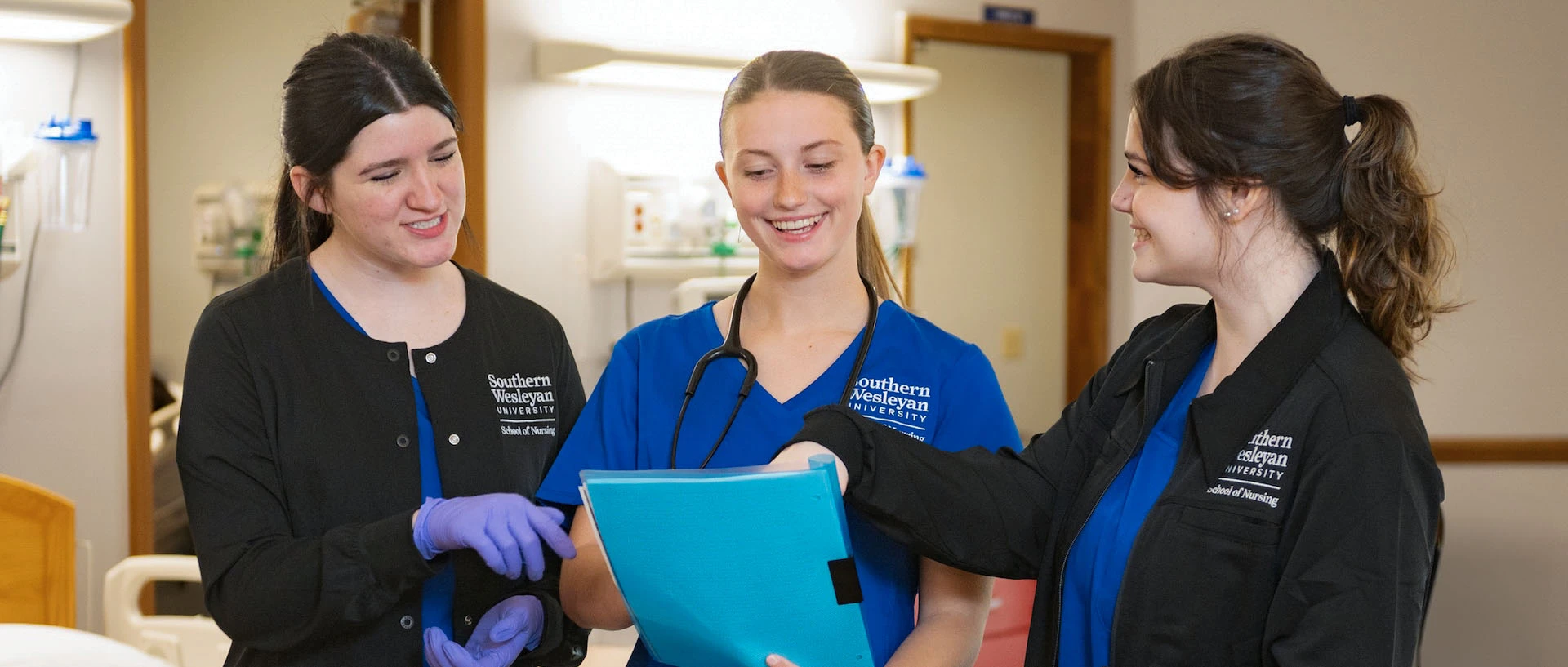
Nursing (BSN)
The Fall 2027 Nursing Application is Now Open
Application Review: January 8 and March 1
Called to Care. Prepared to Serve
Nursing is more than a career — it’s a calling. At Southern Wesleyan University, that calling is nurtured in a biblically faithful environment where students are personally mentored, academically challenged, and formed as servant-leaders prepared to impact the world for Christ. Our Bachelor of Science in Nursing (BSN) is designed to prepare future nurses to care for the whole person—body, mind, and spirit—through evidence-based practice, compassionate service, and strong clinical judgment.
With small cohorts, hands-on learning, and regional clinical partnerships, SWU’s nursing program is built to prepare students for licensure, employment, and meaningful service in healthcare settings across South Carolina and beyond. Terry Hall has been renovated into a nursing training facility with skills and simulation spaces to support immersive learning.
Pathway to Nursing (BSN)
Pre-Nursing
Students pursuing Pre-Nursing at Southern Wesleyan University complete foundational coursework in the sciences, general education, and health-related studies while building the academic and personal skills needed for success in nursing. Coursework includes English I and II, algebra or probability and statistics, general biology, general chemistry, general psychology, anatomy and physiology I and II and other liberal arts courses designed to strengthen communication, critical thinking, and problem-solving abilities through a Christian worldview.
Admission to Southern Wesleyan University and declaration of Pre-Nursing as a major does not guarantee admission into the Upper Division Nursing program.
Progression to Upper-Level Nursing Program
Pre-Nursing students may apply for progression into the Nursing program after completing the required prerequisite coursework and meeting all minimum eligibility requirements. Admission into the Nursing program is competitive and based on academic performance, progression GPA, and additional application criteria established by the School of Nursing.
The School of Nursing reviews each applicant to identify students who demonstrate academic readiness, professionalism, compassion, and a calling to serve others through healthcare.
Upper-Level Nursing
Upper-Level Nursing students participate in a rigorous combination of classroom instruction, clinical experiences, and hands-on simulation training designed to prepare students for professional nursing practice. Students will gain valuable experience in a variety of healthcare clinicals while learning alongside experienced faculty mentors committed to student success.
Nursing students are required to enroll full-time and complete courses in the prescribed sequence. Through faith-integrated learning and state-of-the-art simulation experiences, students are prepared to provide evidence-based, compassionate care that serves the whole person — body, mind, and spirit.
Freshman Students
Once you are admitted to Southern Wesleyan University as a pre-nursing major, you’ll complete your prerequisites then apply to upper-level nursing. Students applying for Fall admission must complete required prerequisite courses by the end of the Spring semester preceding their admission. Students may be allowed to complete select required prerequisite courses by the end of the Summer semester preceding their admission on a case-by-case basis.
Year 1
- Apply to Southern Wesleyan University as a Pre-Nursing Studies student.
- During your first year, submit your application to the Bachelor of Science in Nursing (BSN) program. Dates for opening and closure of applications will be posted on the School of Nursing website. Acceptance letters will be distributed by April 1 each year.
Years 2–4
- Upon acceptance into upper-level nursing, begin nursing coursework, including clinical experiences.
Transfer Students
Submit your application to Southern Wesleyan University, along with your required prerequisites. Once accepted you will be asked to complete the upper-level nursing application.
- English I and II
- Algebra/Trigonometry, Probability & Statistics, or College Algebra
- General Biology
- General Chemistry
- General Psychology
- Anatomy Physiology I and II
Note: While transfer students must meet the minimum of a 2.0 GPA for institutional acceptance, a 2.75 GPA is required for acceptance into the BSN program.
We do not require the TEAS test for admission currently.
Freshman Academic Aid
Based on high school GPA. Renewable for up to four years or 120 SWU credit hours, whichever comes first.
Residential Students
| Scholarship | Amount | GPA |
|---|---|---|
| Presidential Scholarship | $14,000 | 4.3+ |
| Trustee Scholarship | $13,000 | 3.4 – 4.29 |
| Warrior Scholarship | $11,000 | 2.5 – 3.39 |
| Opportunity Scholarship | $10,000 | <2.5 |
Transfer Academic Aid
Based on cumulative GPA from all institutions attended. Renewable for up to four years or 120 SWU credit hours, whichever comes first.
| Scholarship | Amount | GPA |
|---|---|---|
| Transfer Trustee Scholarship | $11,000 | 3.5 – 4.0 |
| Transfer Warrior Scholarship | $10,000 | 3.0 – 3.49 |
| Transfer Opportunity Scholarship | $6,000 | <3.0 |
One Simple Cost. Everything You Need.
SWU’s nursing program uses an all-inclusive student resource model designed to reduce surprise costs and support student success from day one.
| Full Time Expenses - Per Year | Cost |
|---|---|
| Tuition (2026-2027) | $29,500 |
| Combined fees | $3,000 |
| Nursing Student/Program Fee |
$1,500 per semester for 6 semesters |
| Rooms (double) | $4,870 (minimum) |
| Meal Plan | $6,250 |
- No additional textbook purchases
- No separate testing fees
- No surprise costs
- Materials ready from the start
Tuition & Costs | Financial Aid | Scholarships & Grants
Included in the Fee
Textbooks & Course Materials
Digital textbooks, access codes, digital learning platforms, 36-month access, and i-Human virtual simulations.
Testing & NCLEX Preparation
Kaplan full program access, practice and proctored exams, NCLEX readiness tools, and a live NCLEX prep course at program conclusion.
Technology
DocuCare EHR, vSim, secure testing software, Lippincott dosage calculation tools, and Canvas integration.
Program Completion Support
NCLEX review resources and final assessments.
What You’ll Need to Budget Separately
While most program costs are included, students should plan for:
Required Gear
- Nursing uniforms (scrubs, jacket)
- Nursing shoes
- Stethoscope, watch, and basic tools
Health & Compliance
- Background check & drug screening
- Immunizations & physical exam
- Health insurance
Additional Items
- Lab supply bag
- CPR certification (every two years)
The National Council Licensure Examination (NCLEX) is a nationwide, adaptive, pass/fail examination for nurses. There is a specific NCLEX called the NCLEX-RN for those students who have completed a registered nursing program. The NCLEX-RN does not differ for those students who have an associate degree in nursing and those who have a bachelor degree of nursing.
The passing standards for the NCLEX-RN reflect the level of nursing ability required to practice competently at the entry level. Because nursing practice evolves over time, the NCSBN Board of Directors reevaluates the passing standards every three years when the test plans are reviewed.
Meet the Faculty
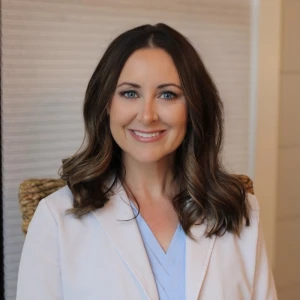
Dr. Tiffany Stewart
Dean of the School of Nursing
View ProfileWhitney Williams
Assistant Professor of Nursing
View ProfileProgram Distinctives
Financially Affordable Education – Competitive tuition designed to remove financial barriers for an affordable, private, Christ-centered education.
Holistic, Biblically Faithful Nursing Education – Grounded in Scripture and evidence-based practice, our program prepares nurses to exercise critical clinical judgment while caring for the whole person—body, mind, and spirit—blending scientific excellence with Christ-centered service.
Transfer-Friendly Pathways – Seamless credit transfers with no waitlist to begin upper-level nursing coursework.
Four-Year Bachelor of Science in Nursing (BSN) – A comprehensive program preparing graduates for professional licensure.
Small Cohorts. One-on-One Mentorship – Intentional faculty investment and stronger clinical placement relationships.
Service-Learning & Medical Mission Opportunities – Hands-on experiences through community health partnerships and global engagement.
Partners






The following 12 Program Learning Outcomes (PLOs) are the foundation of the pre-licensure BSN curriculum at Southern Wesleyan University, incorporating the 10 AACN Domains and two additional outcomes reflecting the spiritual components of the University's core values.
At the end of the BSN program…
- The student will integrate a biblical worldview into nursing practice, demonstrating Christ-like compassion and integrity while serving patients as image-bearers of God and embodying a ministry of healing, hope, and hospitality (Biblical Worldview Integration & Compassionate Care).
- The student will apply Christian ethical principles and responsible stewardship of resources in clinical decision-making, recognizing nursing as a sacred vocation and demonstrating vocational effectiveness as servant-leaders who impact the world for Christ (Ethical Stewardship & Vocational Effectiveness).
- The student will integrate a comprehensive understanding of nursing science, humanities, and related sciences to inform patient-centered care and clinical judgment across the lifespan (Domain 1: Knowledge for Nursing Practice).
- The student will deliver compassionate, holistic, and individualized care that prioritizes the patient's values, preferences, and needs, promoting positive health outcomes for diverse populations (Domain 2: Person-Centered Care).
- The student will promote health and prevent disease for diverse populations through collaborative initiatives, considering social determinants of health, environmental factors, and advocating for health equity (Domain 3: Population Health).
- The student will engage in inquiry, critical appraisal, and application of evidence-based practices to advance nursing knowledge, improve patient outcomes, and contribute to the nursing profession (Domain 4: Scholarship for Nursing Practice).
- The student will apply principles of quality improvement and safety to continuously enhance healthcare systems, minimize harm, and ensure high-quality patient care environments (Domain 5: Quality and Safety).
- The student will collaborate effectively with interprofessional teams, fostering mutual respect, shared decision-making, and effective communication to optimize patient care outcomes (Domain 6: Interprofessional Partnerships).
- The student will engage with healthcare systems and complex organizational structures, adhering to relevant policies and advocating for individual patients and diverse populations (Domain 7: Systems Based Practice).
- The student will utilize informatics and healthcare technologies ethically and effectively to manage information, support clinical judgment, and enhance communication, care coordination, and patient safety (Domain 8: Informatics and Healthcare Technologies).
- The student will demonstrate professional identity, ethical conduct, and accountability in nursing practice, adhering to professional standards, legal parameters, and a commitment to lifelong learning (Domain 9: Professionalism).
- The student will engage in continuous self-assessment, professional growth, and leadership development to foster resilience, well-being, and adaptability in an evolving healthcare landscape (Domain 10: Personal, Professional, and Leadership Development).
- Surgical Nurse
- ICU Nurse
- Pediatric Nurse
- Emergency Room Nurse
- Labor and Delivery Nurse
- Geriatric Nurse
- Hospice Nurse
- Nurse Leader
- Public Health Nurse
- School Nurse
- Home Health Nurse
- Palliative Care Nurse
- Ambulatory Care Nurse
- Behavioral Health Nurse
6%
Projected RN workforce growth over the next decade.
90%
Of nursing students in South Carolina have a job offer at graduation.
96%
Employed 4–6 months after graduation in South Carolina.
$83,000–$114,000
Estimated annual RN salary range in South Carolina.
Data sourced from Glassdoor.com and US Bureau of Labor Statistics - https://www.bls.gov/ooh/healthcare/registered-nurses.htm
